In toxic community systems, if we want to understand why we may be experiencing, or have previously experienced, collective hostility, social exclusion, scapegoating, humiliation, or the recruitment of multiple people into treating us as though we are somehow the sole problem, group narcissism may be part of what is happening. This can be especially true when the community itself is inherently dysfunctional at its core, yet we are made to feel as though having healthy boundaries, maintaining our personal agency, or refusing to participate in unhealthy dynamics is somehow what makes us the problem.
While narcissistic traits can exist within all of us to varying degrees and can express themselves differently from person to person, group narcissism can develop when a community, organization, or social group becomes so invested in its own image, superiority, righteousness, or special status—that protecting the group’s collective ego becomes more important than honest self-examination, being a person of actual integrity, taking one’s own growth and inner development seriously, and even recognizing and respecting the basic dignity of the people that they target. And within that kind of system, if we question the group’s behavior, refuse to conform to its expectations without question, expose contradictions within its values, or simply maintain a strong sense of personal agency, we can begin to be perceived as a threat.
Once we have been cast into the role of the outsider, dissenter, or problem person for these types of unhealthy community systems, the group may begin interpreting nearly everything we do through a negative lens, where no matter how reasonable our intentions or actions may actually be, they are continually filtered through the negative perception of us that the group has already established and reinforced. And no matter how decent we may actually be as human beings, or how much we ourselves are capable of inner transformation and personal growth, that decency and capacity for growth may simply not matter in their eyes because they have already become invested in seeing us through the role they have already collectively assigned to us, and because the community itself may place little value on inner transformation, personal growth, or the deeper work of becoming healthier human beings in the first place.
This means that the same healthy boundaries that we established with the group in order to protect our own well-being, dignity, and personal agency—which contributed to us being cast into the role of the outsider, dissenter, or problem person from the outset—those same boundaries will continue to be regarded by them as “disrespect. It also means that when we maintain our independence from their approval, expectations, or attempts to unfairly control us in an authoritarian manner, they will continue to interpret that independence as “rebellion.” And it means that when we continue exercising discernment about unhealthy patterns, contradictions, or harmful behavior within the group, they will still dismiss that discernment as “arrogance.”
So, even after being cast as the outsider, dissenter, or problem person, when we still refuse to go along with the unhealthy dynamics within the community system, or when we still refuse to cater to any of the dysfunctional leadership styles that may be prevalent within it—which are most likely enabling its broader dysfunction—that refusal will still serve, in their eyes, as further evidence that we are somehow difficult, unreasonable, or unstable. And in their minds, that perception then becomes further justification for any continued hostility, disrespect, humiliation, or other forms of mistreatment that the community, organization, or social group feels the need to continue directing toward us
When these negative ideas about who we are, along with the false assumptions that they make about why we behave the way that we do, begin to be shared, repeated, and validated by multiple people within the community, whether by supposed community leaders or cliques of people within the group, those ideas and assumptions can gradually harden into a collective narrative about us. This is where scapegoating becomes socially reinforced, as one person or a smaller number of people can come to be repeatedly blamed, negatively characterized, or treated as the source of problems that may actually belong to the broader community system itself or to dysfunction within its leadership, while the deeper dysfunction within the group or among those leading it is continually placed onto scapegoats instead of being honestly recognized and confronted within the system itself and by those responsible for leading it.
So, instead of individual members—or the broader community itself—stopping to question whether the community may be behaving unfairly, or whether there may be spiritual growth and self-examination needed within the community at a very deep, systemic, underlying level, or within the way its leadership is functioning, people within the community instead keep reinforcing one another’s negative view of us. And as this continues, a closed feedback loop begins to form in which the community’s collective agreement about who we are, what our intentions are, and why we behave the way that we do is mistaken for objective truth.
This is where it becomes important to remember that collective agreement is not the same thing as objective truth. And the fact that multiple people within a community system have agreed upon a particular narrative about us, it does not automatically make that narrative accurate. Sometimes, what appears to be widespread agreement inside of a community system is actually the result of a group protecting its shared identity, social hierarchy, and collective self-image from anything—or anyone—that forces it to look more honestly at itself.
This is why it is important for us to remember that there is not necessarily anything inherently wrong with us as individuals simply because a community has collectively decided to treat us as though there is. Because if we know that we have sincerely examined our own behavior, taken accountability where accountability was genuinely ours to take, remained willing to grow where growth was needed, and continued trying to conduct ourselves with integrity, then the collective disapproval or mistreatment of a group does not automatically prove that there is something fundamentally defective about who we are. Sometimes, what a toxic community rejects, condemns, or attempts to diminish within us may have far more to do with the role it has assigned to us and the narrative it has constructed around us than with the actual substance of our character.
This means that the very qualities that cause us to be negatively perceived within a toxic community—qualities such as our willingness to think independently, to establish healthy boundaries, to examine ourselves honestly, to question unhealthy behavior, to take responsibility for our own growth, and to refuse to participate in destructive group dynamics—that may actually reflect a greater degree of mental, emotional, and spiritual health than the community system itself is presently capable of recognizing, encouraging, integrating, and embodying.
And that having been made a target by a community, organization, or social group that is operating from a deeply entrenched and unhealed place of group narcissism, it is actually a reflection of our refusal to become psychologically, emotionally, and spiritually assimilated into the dysfunction of the community around us.
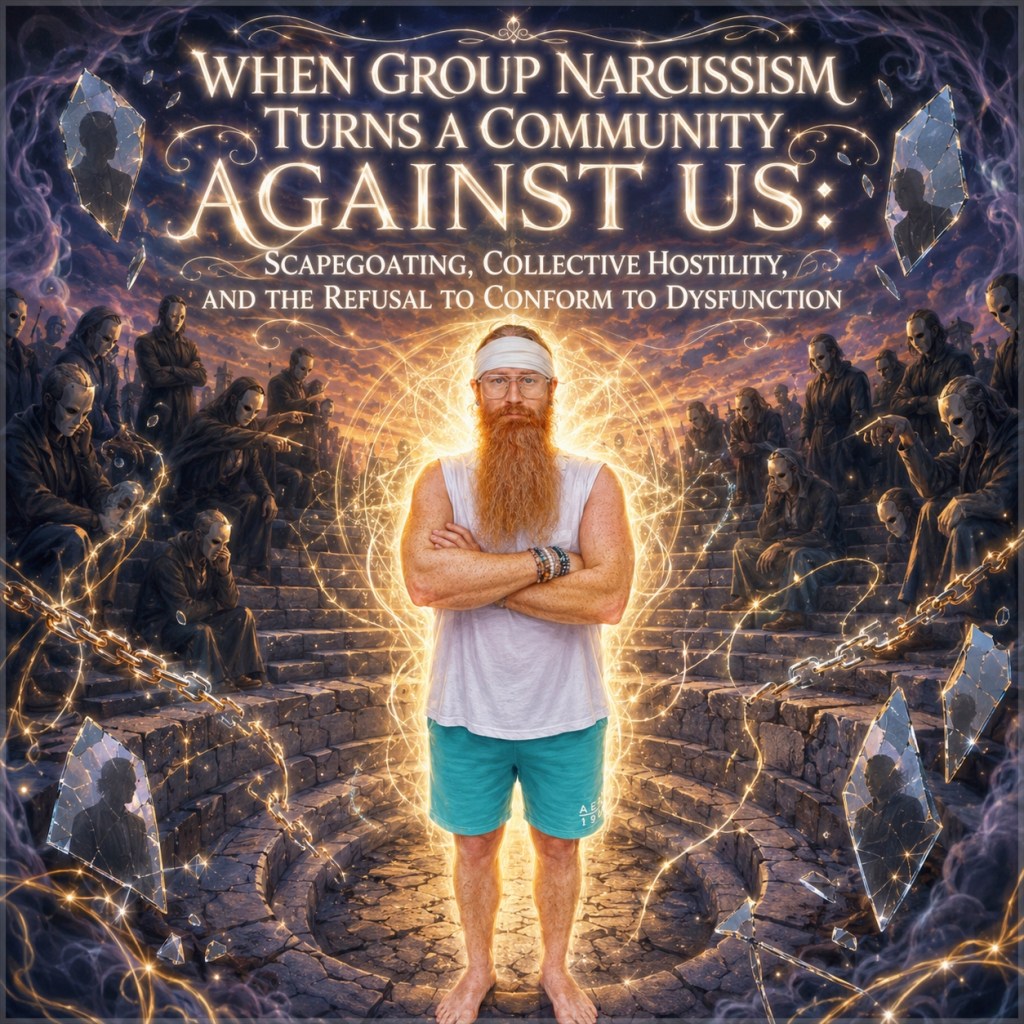
When Group Narcissism Turns a Community Against Us: Scapegoating, Collective Hostility, and the Refusal to Conform to Dysfunction
5–8 minutes