If you grew up in a religious environment, experienced trauma at the hands of the people within it, and consequently rejected God, part of your shadow work may be to integrate your own belief in God and sense of spirituality into a genuine and embodied expression within your life—the part of you that was buried, disowned, or pushed into the unconscious because your experience of the Divine within that religious environment became entangled with fear, shame, control, and spiritual abuse.
This does not mean returning to the same religious system that harmed you, excusing what was done to you, or forcing yourself to believe in God exactly as the people within that system did. It just means separating God from the distorted image of Him that those who harmed you imposed upon your mind, so that the people who wounded you are no longer allowed to remain the final authority over your spiritual life.
This means that your healing from a harmful religious environment may involve reclaiming your freedom to seek, to question, to discern, and to form a relationship with the Divine on the basis of personal agency—a process in which learning to explore spiritual truth without fear or coercion, and without surrendering your conscience to another person or institution, becomes essential to restoring your ability to think, discern, and make spiritual choices for yourself.
As this sense of spiritual freedom and discernment are restored within you, you may become more receptive to the ongoing transformation of your own heart, soul, and mind that can emerge through the genuine practice of spirituality and faith. And while some may not feel called to reclaim the faith from which they were wounded, finding spiritual meaning and connection with the Divine through another path instead, others may eventually reclaim the very faith that was once weaponized against them and, in reclaiming it for themselves, come to embody the spiritual maturity that those who harmed them failed to demonstrate in their own lives.
If you do not enter your shadow and integrate the wounded spiritual part of yourself, the trauma does not simply disappear because you have rejected the religious environment in which it was formed. It may continue operating beneath the surface of your conscious awareness, manifesting through intense reactivity, defensive absolutism, compulsive opposition to anything associated with God, or an inability to distinguish genuine spirituality from the distorted version of it that was imposed upon you.
Unresolved religious trauma can even reappear through new and seemingly liberating forms of spirituality. But because a person has never truly worked through the trauma underlying their rejection of religion, they may polarize into a form of spirituality that defines itself primarily through opposition to the faith that once wounded them, where they mistake reaction against the old system for genuine spiritual freedom and inner transformation itself.
In this state of spiritual overcorrection, wantonness may become central to their entire personality, with the rejection of any kind of restraint, moral accountability, or spiritual discipline being treated as evidence of liberation, where every form of excess, impulsivity, or resistance to healthy boundaries is elevated into an expression of authenticity, empowerment, or spiritual awakening.
A person may also leave one controlling religious belief system only to become attached to another, replacing the dogmatism of one expression of faith with the dogmatism of another. This is because, on a subconscious level, the patterns of fear, dependency, and external authority that shaped their original religious experience may continue influencing what they are drawn to, what they trust, and what they accept as spiritual truth.
But while the outward form of religion may change when they enter a new spiritual system, their failure to go inward and to confront the unresolved wounds that are shaping their relationship with faith can prevent them from recognizing that they have become deeply embedded within a different, equally authoritarian religious tradition—one in which the same unhealed relationship with spiritual authority has been reorganized beneath different beliefs, symbols, and language, leaving them just as disconnected from their own conscience, personal agency, and genuine inner transformation as they were before.
Unresolved religious trauma can even manifest through political movements, where political ideology can come to function as a substitute religion, taking on the same rigid certainty, moral absolutism, idealization of authority figures, and hostility toward anyone who questions the group’s beliefs.
The doctrines, symbols, and language may no longer appear religious, but the underlying psychological structure can remain largely unchanged, with political belonging replacing religious belonging, ideological conformity replacing doctrinal conformity, and loyalty to the movement replacing submission to the religious authority that they rejected. In this way, a person may believe that they have liberated themselves from dogmatic religion while still continuing to reenact its most psychologically restrictive patterns through a different system of collective identity and external authority.
Beyond the ways unresolved religious trauma can reappear through alternative forms of spirituality, authoritarian religious traditions, and political movements, one of its more common manifestations occurs when people make atheism the central organizing identity of their entire personality and adopt it as a reactive posture toward the faith that once wounded them—a heart posture that is sustained by the continual rejection, ridicule, or dismissal of anything associated with God, spirituality, or faith.
In such cases, disbelief can begin to take on the same rigid certainty about what is true, and it can also reproduce the same intolerance toward other perspectives that characterized the religious environment in which they were wounded. Now, the contempt they once found themselves on the receiving end of as nonbelievers—or even as people who simply did not rigidly conform to that environment’s doctrines and expectations—is redirected toward those who believe in God, who practice a faith, or who simply embrace a sense of spirituality in general.
In this way, they become the very people who pressure others to conform—only now, it is conformity to an approved secular worldview rather than to religious doctrine. So, the content of their beliefs may have changed, but on a deep, underlying level, they have become religious zealots in their own right, with disbelief occupying the same psychological place that dogmatic religion can occupy within a person.
Unresolved religious trauma can manifest in so many different forms and ways, and even I am still working through my own religious wounds and the ways that they have shaped my relationship with faith. And through shadow work, I have come to understand that, even within my own journey of spiritual liberation and inner transformation, I must remain willing to examine the places where unresolved pain may still be influencing my beliefs, reactions, perceptions, and relationship with God.
Shadow work is therefore not something I am merely prescribing to others; it is an ongoing process that I must continue practicing within myself so that I do not unconsciously reproduce, through a different spiritual form, the same resistance to honest self-examination, moral accountability, and inner transformation that I am learning to recognize in the systems that once wounded me.
I also know that religious zealotry, moral superiority, and the tendency to mistake my own spiritual convictions for unquestionable truth are things that can manifest within me in my own right, and I am learning to confront, integrate, and transform them into healthier expressions of faith.
While I have not listed every way unresolved religious trauma can manifest—as there are simply too many to address here—the examples I have given reveal that changing our beliefs, communities, or spiritual identities does not automatically mean that we have transformed inwardly.
We can reject one system, adopt another, and still carry the same unexamined wounds, compulsions, defensive patterns, and unhealthy relationships with spiritual authority into an entirely different worldview. And without confronting how those wounds continue to shape us inwardly, we may simply give them new beliefs, symbols, and language through which to express themselves—which is very often what happens when outward change is mistaken for genuine inner transformation.
This is why going into our shadow and integrating the wounded spiritual parts of ourselves is necessary for genuine inner transformation, because without that integration, the beliefs we hold may change while the deeper wounds shaping our relationship with faith, authority, and the Divine remain largely untouched—allowing their influence to permeate every new worldview, belief system, or identity we adopt, whether we are consciously aware of it or not.
And regardless of whether we reclaim the faith tradition within which we were wounded and learn to embody that faith in a more sincere, ethically grounded, and spiritually mature way, find our way toward the Divine through another path, embrace some combination of both, or perhaps follow a path that has no formal religious or spiritual identity at all, integration does not require us to return to the beliefs, institutions, or practices that harmed us.
Instead, it means becoming conscious of how religious trauma continues to shape our perceptions, reactions, spiritual choices, and relationship with the Divine, so that we do not unconsciously carry the same unhealed relationship with faith and spiritual authority into another religion, political movement, secular identity, or form of spirituality.
With everything that I have now touched on, I also want to acknowledge that this kind of healing is rarely completed all at once—if healing is even something that ever truly ends—and that none of us is ever entirely free from the influence of our wounds simply because we have become aware of them, have learned to recognize their effects, or have begun working through them.
This means that the best thing we can do is to remain honest about what still needs to be healed within us, to stay open to continued self-examination, and to keep choosing the inner work that allows our spirituality to become an expression of personal agency, integrity of conscience, and genuine inner transformation—rather than a vehicle through which our unresolved wounds can continue to speak.
Generational Trauma, Integration, Liberation, Polarization, Politics, Reflections, Religion, Shadow Work, Spirituality
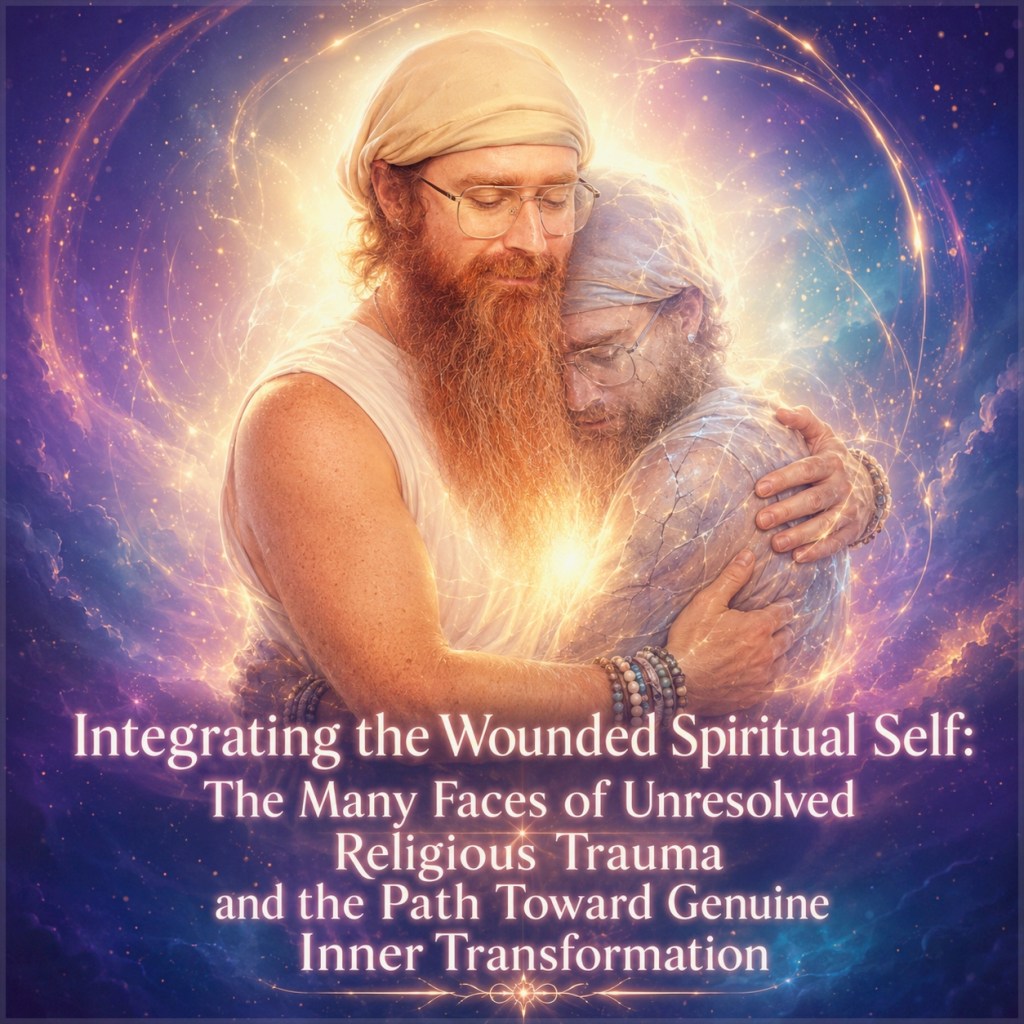
Integrating the Wounded Spiritual Self: The Many Faces of Unresolved Religious Trauma and the Path Toward Genuine Inner Transformation
7–11 minutes