When one is born into a religious environment, children get their psychological and spiritual autonomy taken away literally the day they are born. Some go their whole lives living as a false self composed entirely of what their external environment shaped them into—never coming to the conscious realization that they don’t actually have an authentic self beneath the roles, rules, and expectations that they’ve been conditioned to perform. They are just carriers of inherited belief systems, moving through life on psychological autopilot—never pausing long enough to question whether the thoughts they think, the values they defend, or the fears they carry were ever consciously chosen, having absorbed all of it long before they even had the capacity to consent, self-reflect, or decide who they actually are in a truly sovereign manner.
But some of us, over the course of our lives—some earlier, some much later—we wake up from that programming. And when that happens, it is not a gentle process. It can be deeply destabilizing, unsettling, and disorienting. This is especially true for those of us who awaken later in life, after entire identities, relationships, and life structures have already been built on inherited beliefs, roles, and narratives that were never consciously chosen, and on expectations imposed long before we had the capacity to question them or consent to their authority over our lives.
And so, when this awakening happens, it marks the moment when the inherited identity structures and the roles we were born into begin to fracture—as the beliefs we were taught to identify with as “who we are” begin to feel foreign, constricting, and hollow. This often pulls us into what some people call a dark night of the soul, where the familiar frameworks that once gave us certainty in life collapse, where what we once clung to for meaning dissolves, and where the false self we have been living in up until that initial awakening point can no longer be maintained. And in that space of collapse and unknowing, we are forced to sit with very raw and destabilizing states of confusion, grief, and disorientation as our old identity dies—where, in due time, which very often takes many years, the inner dismantling makes room, slowly, steadily, and painfully, for the eventual emergence of an authentic self rooted in our own inner authority rather than external conditioning we did not consent to.
So, when the time comes in the lives of those who awaken from their conditioning, this awakening forces a reckoning—between who we were trained to be in order to belong, and who we actually are beneath all the conditioning, whether that conditioning came from family, religious institutions, cultural norms, or other systems of authority. And once that awareness clicks—once we realize that we have been living as a false self, as a programmed identity that was never consciously chosen—there is no going back. Because once you expand your awareness, you can’t unknow that your sense of self was externally authored without your consent, or that you’ve been living an entire life disconnected from your own inner truth and self-authored identity. And from that point on, after that threshold is crossed, the journey forward becomes one of dismantling the false self, reclaiming our inner authority, and courageously rebuilding a life rooted in conscious choice rather than unexamined inheritance.
For those who are on the same sort of journey as me, what you are doing is truly remarkable—and you should be proud of yourself for having the courage to question, to deconstruct, and to choose yourself consciously. Not everyone wakes up from their conditioned identity, and many people, believe it or not, live out their entire lives inside of identities that they never truly consciously chose for themselves, and then they die never having known who they actually are beneath all of their conditioning. This means that for much of their lives, they are simply carrying forward—and unconsciously living out—inherited belief systems, roles, expectations, and identities, moving through life on psychological autopilot—equating what was inherited with what is authentic, and defending inherited scripts as if they were self-chosen.
And while I am not saying we should throw the baby out with the bathwater and completely reject everything we inherited, we can choose to keep what genuinely resonates with us—that which is life-giving, psychologically healthy, ethically coherent, and rooted in growth, integrity, and inner freedom, rather than being complete by-products of systems and dynamics that are rooted in fear, control, or enforced conformity. This way, what remains is no longer something we obey out of conditioning, fear, or social pressure, but something that we can relate to consciously, selectively, and on our own terms—not because it was imposed on us before we had the capacity to choose, nor because we were conditioned to accept it without question, nor out of fear, guilt, or inherited obligation, but because it has been consciously examined and freely embraced.
So, to end this reflection, while there is so much more that could be said about this process of awakening and self-authorship, what matters most is this: waking up from a conditioned identity is not a betrayal, a failure, or a rejection of meaning in life on our part. Rather, waking up and doing the work that it takes to dismantle the false self and live consciously—perhaps for the very first time in our lives—is an act of maturity, integrity, and self-responsibility. And with that responsibility comes a fundamental shift in how we orient ourselves to life, shifting from inherited scripts to conscious awareness, and from external control to inner authority. And that choice, while it can be difficult and deeply uncomfortable at times—especially given the social consequences we may experience as a result—it is also what makes our lives truly our own, and aligned with who we actually are, and not who we were shaped to be by people and systems that never honored our sovereignty in the first place.
Also, to be clear, when we experience adversity or resistance along this path, it doesn’t mean that we are bad, evil, or wrong for choosing it—despite what some people may direct toward us through their reactions, assumptions, or behavior when they try to make us feel ashamed, guilty, or wrong for becoming more self-directed. And more often than not, it is those who are still living from their own false selves who tend to interpret what we are doing—which is stepping into the light of our own authentic nature beyond what we were conditioned to be—as a threat. And while it may hurt to experience rejection, pushback, or alienation from others as a result of this process of waking up and reclaiming our inner authority, all we can really do is hope that they too, in their own time, may one day wake up from their own conditioned identity and reclaim their sovereignty after years spent living inside an identity they never consciously chose for themselves. But even so, that does not mean we should delay, suppress, or abandon our own journey of growth, healing, and self-realization while waiting for them to do the same.
And that we should continue with what we are doing, with or without external approval, validation, or understanding—because our growth, integrity, and inner freedom are not contingent on anyone else being ready to face their own journey of awakening and self-examination.
Adversity, Collective Abuse, Destructive Cults, Generational Trauma, Liberation, Reflections, Religion, Sovereignty, Spirituality
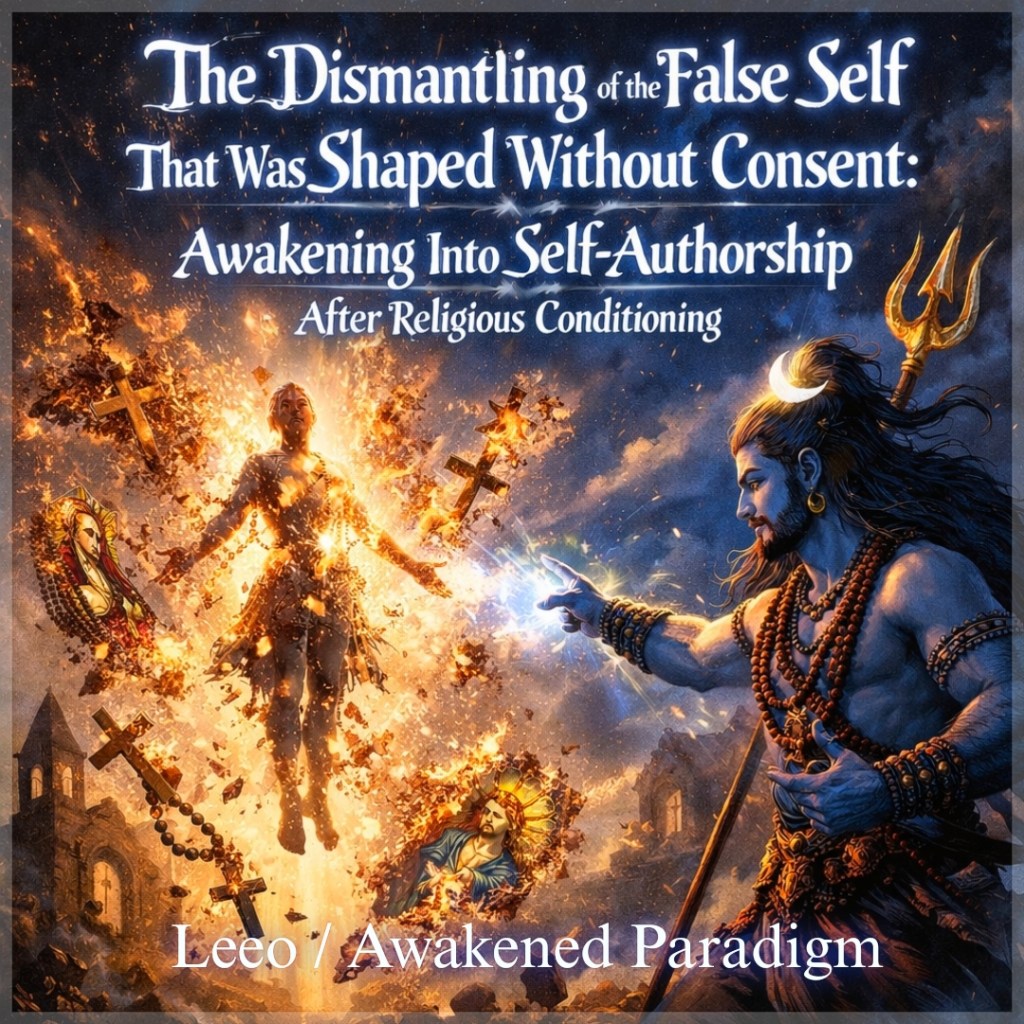
The Dismantling of the False Self That Was Shaped Without Consent: Awakening Into Self-Authorship After Religious Conditioning
5–8 minutes

 Awakened Paradigm