
If you’ve got people who don’t do their individual inner work, who are also in dysfunctional or consciousness-stagnant partnerships or marriages, who are attempting to preserve their existing relational structures and sense of stability while refusing to interrogate their own participation in relational dysfunction, in certain contexts, social settings, or environments that reward appearance over integrity, accountability to one’s own processes of inner development, and having depth of inner substance, instead of turning inward, they will often seek out an external person to be the problem for their own inability to confront, question, or change the relational patterns, power imbalances, emotional disconnection, or unresolved conflicts embedded in their personal and relational lives, rather than cultivating the self-awareness required to interrupt those dynamics.
In dysfunctional relationships, maintaining the appearance of stability often takes precedence over addressing what’s actually broken or stagnant in the inner life of the relationship, so in order to protect the relationship from scrutiny, people within these dysfunctional relationships need a scapegoat to absorb the tension, to deflect scrutiny, and to preserve the fragile equilibrium of the maladaptive relational structure that they’re so invested in maintaining—someone onto whom their relational discomfort and unresolved conflict can be displaced so that the relationship itself never has to be honestly examined or fundamentally changed. And when it comes to preserving that illusion of stability, because of their need to externalize tension and protect their deeply unhealed and unexamined relationship by designating a scapegoat, anyone who disrupts the dysfunctional equilibrium they’ve learned to live inside—whether unintentionally, by existing outside of its unspoken rules, by maintaining personal integrity and psychological coherence, or by disrupting it through difference alone—can be framed as a problem, becoming the next repository or simultaneous carrier of blame or containment, rather than as a mirror reflecting what the relationship itself refuses to face. And in many cases, it isn’t even about disruption at all; the relationship simply requires an external container, and the role of scapegoat will be assigned regardless of an individual’s actual behavior.
This means that when couples are operating from unresolved inner dynamics of personal and relational stagnation—where dysfunction is rooted in mutually arrested psychological development, a mutual limitation in reflective self-awareness, and a shared avoidance of how their relational dynamics affect those around them—instead of engaging in honest self-examination and taking responsibility for their own relational patterns, it’s often safer for the relationship to externalize tension onto a third party or even embed it into a wider community structure through gossip, alliance-building, or collective scapegoating than to risk the destabilization that would come from accountability or meaningful change within the partnership itself. But what they’re doing isn’t healthy, and it only leads to more personal and relational dysfunction, where a deep-seated avoidance of accountability becomes further entrenched, the underlying issues within the relationship remain unresolved, trust and intimacy continue to erode, and the cycle of displacement, tension, and relational decay continues to intensify rather than heal.
So, when people in partnerships or marriages make someone a target—whether that person reflects what the relationship refuses to face by naturally existing in an emotionally authentic field of presence that stands in direct contrast to the emotional dishonesty the individuals within the relationship and the relationship itself are built on; or whether the person disrupts the relational equilibrium by maintaining consistent boundaries, naming observable patterns, or refusing to participate in their avoidance; or whether the couple is actively seeking a scapegoat to offload unresolved tension for their own sense of stability (or some combination of all of these)—what’s actually happening isn’t about the person being targeted at all, but about the relationship’s need to protect itself from disruption by redirecting pressure outward rather than confronting what is broken, underdeveloped, or stagnant within it.
And many times, inside of spaces that reward appearance and shallow forms of social belonging over accountability to one’s own processes of personal growth, self-examination, inner development, and having depth of inner substance, these couples will essentially turn the social environment into a buffer zone for their unresolved relational tension and avoidance of change—not only within themselves as individuals, but within the core operating system of their partnership—using group dynamics to diffuse the pressure of their unresolved conflict, to normalize and conceal the stagnation of their individual and relational consciousness, and to distract from or displace their dysfunction rather than address what’s actually broken between them.
And if an environment has been stagnated for a while and multiple couples aren’t doing the much-needed inner work—not only for themselves as individuals, but also for the growth of their partnership and for the psychological and emotional well-being of the people around them—then that environment often becomes saturated with unexamined tension, normalized dysfunction, and misplaced blame, creating a social atmosphere where stagnation of consciousness is reinforced, scapegoating of others is enabled, and the well-being of individuals external to the relationship’s unresolved dynamics or the broader community’s collective stagnation of inner development is compromised rather than consciously protected.
This means that these conditions within these environments don’t just arise in a vacuum. Rather, they are often sustained by couples, family systems, and shared relational ecosystems that are deeply entrenched in survival-based relational patterns, an avoidance of self-examination, and a rigid attachment to patterns of collective resistance to psychological development. And that those sustaining these systems where these adverse conditions arise, for nuance’s sake, tend to be shaped by unexamined generational conditioning, stagnation of consciousness, and adverse relational templates that they most likely inherited from the social environments that shaped them as they grew up, came of age, and were further influenced by well into adulthood—environments that themselves were marked by arrested development, limited self-awareness, and a persistent resistance to psychological and emotional growth at their core.
But just because we understand that they were shaped by generational conditioning that normalized dysfunction and emotional avoidance, toxic religious environments that may have stunted their ability to grow intellectually, political conditioning that narrowed their capacity for nuance and self-reflection, or other adverse social frameworks that discouraged inner development, that understanding does not absolve them of responsibility for the harm they perpetuate when they refuse to examine, interrupt, or outgrow those patterns as adults. And that responsibility is even more pronounced when two adults in a partnership or marriage remain unwilling to engage in honest self-examination, accountability, or inner growth together—because those unexamined patterns from their upbringing and conditioning don’t just disappear; they become reinforced, normalized, and amplified within the relationship itself, often leading to cycles of scapegoating others and infecting communal structures with their unresolved relational dysfunction. And if they have children, the cycle is not only sustained but transmitted forward, shaping the next generation through the same unexamined dynamics, emotional limitations, intellectual rigidity, and relational distortions that were never consciously examined or interrupted.
And for those of us who have already been doing the work, and who continue to do that work to this day, it becomes essential to recognize when we’re being scapegoated by a couple or a community structure that has been infected by the unhealed dynamics of collective relational dysfunction, and it is equally essential to recognize when we’re being pulled into relational or social patterns that have nothing to do with growth, healing, or mutual accountability. Because in those moments, choosing discernment, boundaries, and self-respect becomes an act of self-preservation and integrity—rather than sacrificing our well-being to sustain or enable systems, relationships, or environments that refuse to evolve.
So, while we can’t force people to grow in these stagnant relationships, environments, or social ecosystems—we can take a step back from being overly responsible for their unresolved inner dynamics, relational dysfunction, or resistance to self-examination—even when they try to make us a target and scapegoat us—and instead redirect our energy toward our own growth, integrity, and psychological well-being.
In doing so, we stop participating in cycles, roles, entanglements, and relational burdens that were never ours to carry, and we reclaim the right to orient our lives around depth of inner substance, clarity of inner knowing, and conscious development—rather than being pulled into maintaining relational systems that depend on avoidance, displacement, and stagnation to survive.
And if the people in these unexamined relationships, communal environments, and social ecosystems continue to try and blame us and scapegoat us instead of going within to examine themselves, take responsibility, and do the work that they’ve been avoiding, they only give us more clarity about who they are, more confirmation of why disengagement from them is necessary, and more resolve to remain anchored in the depth of our own inner substance, personal integrity, and disciplined commitment to conscious development in our own lives and inner paths—while their continued deflection exposes the very stagnation and avoidance they rely on to remain unexamined.
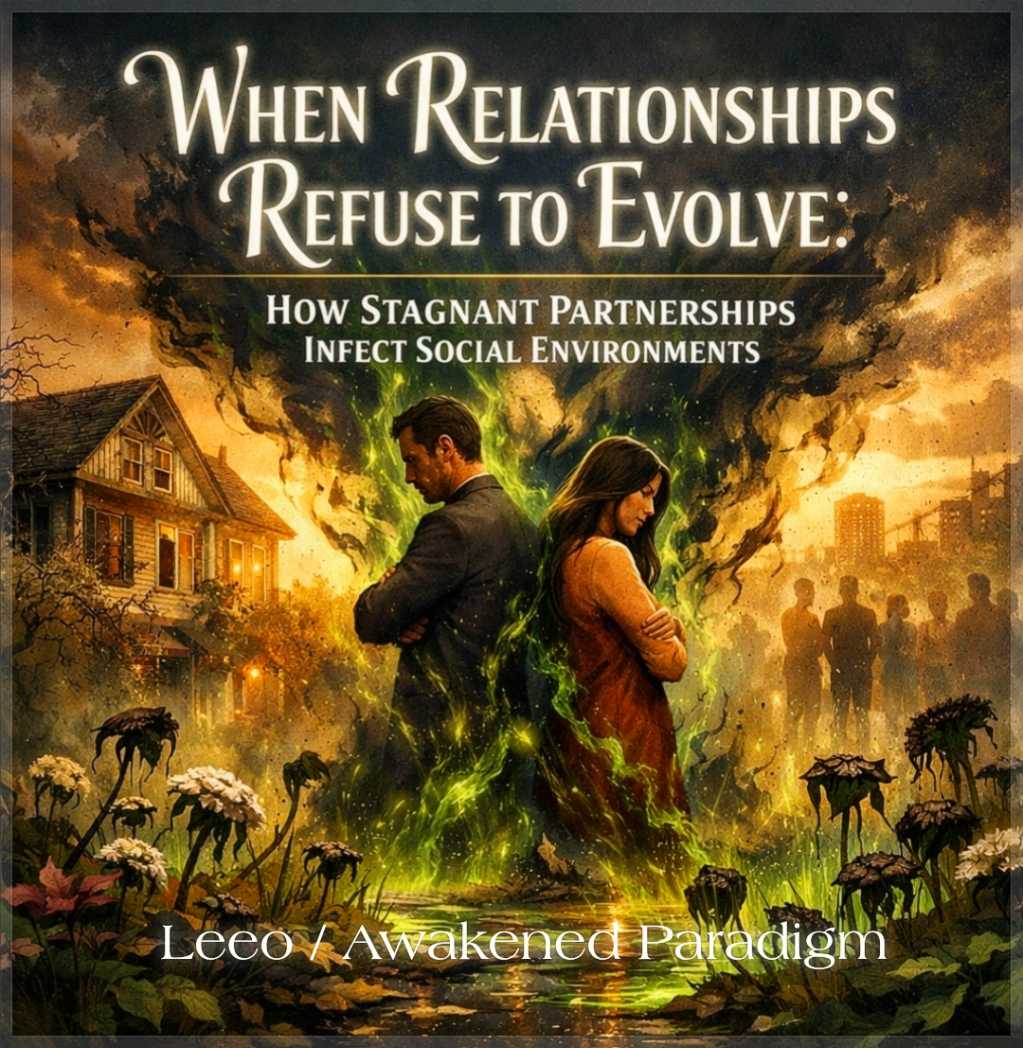
When Relationships Refuse to Evolve: How Stagnant Partnerships Infect Social Environments
6–9 minutes

 Awakened Paradigm