
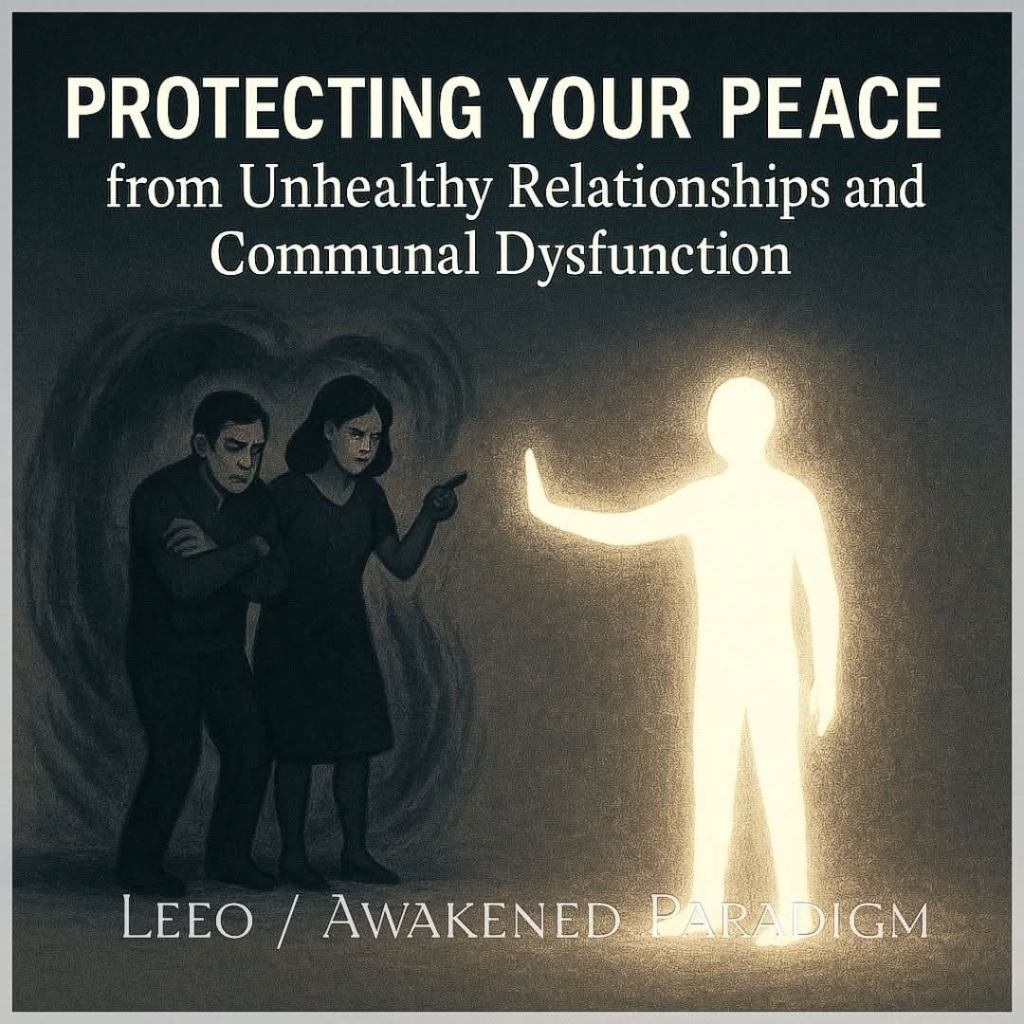
Setting healthy boundaries for ourselves with people that are in miserable and psychospiritually stagnant marriages is crucial, because their unresolved issues and constant unrest can easily spill over onto others. This means that if we don’t establish firm and healthy boundaries for ourselves in our own lives, we can find ourselves drawn into dynamics that were never ours to carry in the first place, where we are expected to absorb the tension they create as a couple or to tolerate their lack of individual growth and progress in their relationship.
On top of that, many of these couples hide their dysfunction behind a carefully maintained superficial facade, presenting themselves as stable, happy, or even exemplary in public, all while the truth underneath the farce tells a very different story. And that false exterior can also pressure those around them into going along with the performance, as if keeping up appearances matters more than addressing the unresolved conflict, immaturity, and lack of growth beneath the surface. That’s why our boundaries protect us from being entangled in that kind of façade, reminding us that we are not required to participate in their performance or obligated to sacrifice our peace, just to uphold their relational image of happiness and togetherness that actually crumbles under the weight of closer inspection. Instead, they give us the freedom to step away from cycles of dysfunction and to cultivate interactions, connections, and environments that are authentic, nourishing, and aligned with our own psychospiritual development.
This doesn’t even have to be limited to people who are married though, as it can also extend to people in relationships of all kinds. So, whether it’s a couple dating, living together, or simply locked in an unhealthy dynamic, the same principle applies, which is that when two people refuse to grow, they will often lean on the people around them to absorb the fallout of their choices. This means they might use charm, guilt, or that same superficial image of being the ‘perfect couple’ to avoid addressing the deeper reality of their own stagnation. And if we don’t recognize this, we can end up entangled in a web of dysfunction that was never meant for us to get stuck in and dragged down by to begin with, and that’s why our boundaries are not just an act of self-preservation for us, but also a declaration of our commitment to authenticity, honesty, and depth of character in every connection that we allow into our life experience.
But if you’re like me, and just keep to yourself and don’t deal with people too much at all, you can still become a target inside of communal spaces. Because the reality is, even when we choose solitude or stay in our own lane, the relationship problems of others don’t always stay neatly confined, as their unresolved chaos, lack of personal growth, and refusal to face themselves has a way of bleeding outward, reaching into spaces where it doesn’t belong, and pulling in those of us who never asked to be a part of it. So, this means that people in these unhealthy relationship dynamics will often search for scapegoats and push their chaos onto others, offloading what they refuse to deal with in themselves, just to distract from their own stagnation. And in communal environments, whether that’s a neighborhood, a workplace, a religious group, or just a circle of acquaintances, being a person who shows signs of authenticity, integrity, clarity of thought, and depth of character is often enough to put you in direct line of their sights.
And it’s precisely because of this dynamic that boundaries become vital for those of us who do show signs of authenticity, integrity, clarity of thought, and depth of character. Because when dysfunctional, stagnant, and psychospiritually underdeveloped couples sense that we won’t conform to their expectations or bolster their carefully crafted facade of stability and relation harmony, they may try to discredit us, isolate us, and push us into interactions that drain our energy, where they may even attempt to get us in trouble as a way of deflecting from their own dysfunction. And while it’s not always possible to see it right away—as sometimes we only recognize it after experiencing it firsthand—the sooner we do become aware of it, the sooner that we can step back without guilt, refuse to carry what was never ours to shoulder, and to give ourselves permission to remain grounded in the strength and steadiness of our own presence of being.
Because at the end of the day, our well-being, peace of mind, and personal journeys of psychospiritual growth are far more valuable than conforming to, or enabling, any shallow performance of harmony, false unity, or a superficial show of relational health within a dysfunctional communal space. Because in such spaces, people are often expected to pretend that those who are married or in relationships aren’t showing clear signs of immaturity, unresolved conflict, and lack of growth (even when they attempt to conceal it behind a polished image, selective charm, or a carefully curated reputation designed to distract from what’s really going on). And that’s not something we are obligated to participate in, because pretending that their relational dysfunction is healthy only keeps us tethered to cycles that drain our spirit and that disrupt our peace, instead of keeping us aligned with energies that nurture our growth and that safeguard our well-being.


 Awakened Paradigm