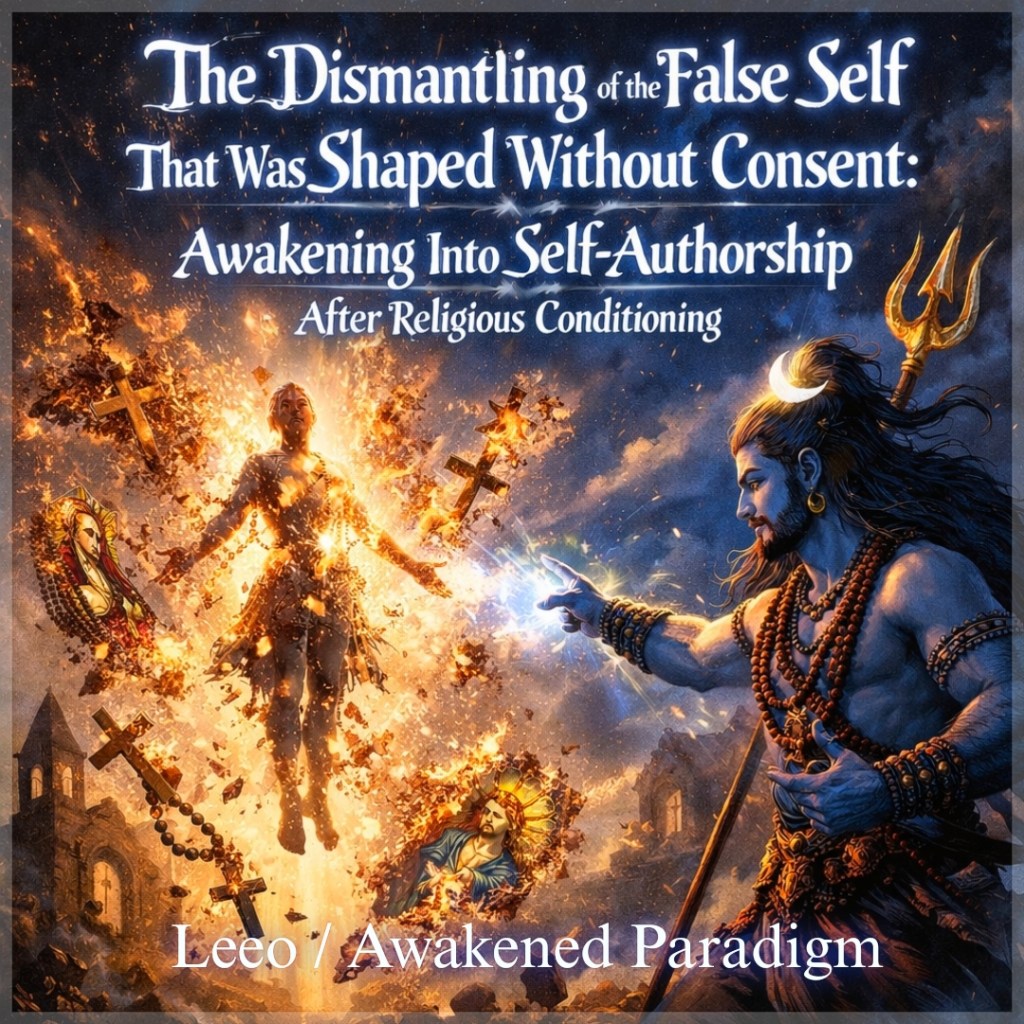
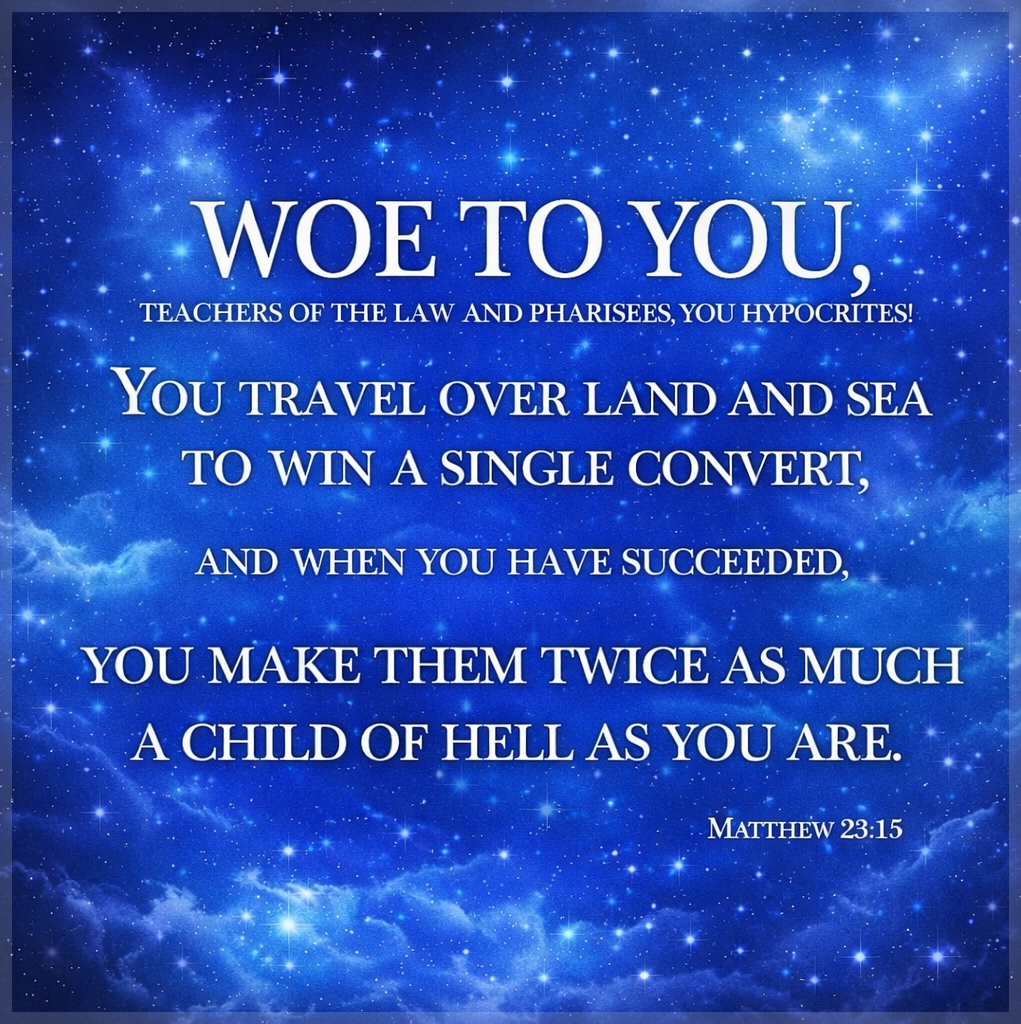
I am against ALL forms of legalistic, Pharisaic religion no matter which culture, background, or tradition one may come from. Because the moment a belief system becomes an instrument of absolute domination—used to enforce rigid rules, to strip away personal autonomy, and to silence genuine inner discernment—it ceases to be about the living pursuit of moral clarity, the cultivation of authentic wisdom, and the kind of inner refinement that shapes both character and conscience.
Instead, it turns into a suffocating apparatus of staged righteousness, performative virtue, and controlling orthodoxy, where the performance of subjective religious “goodness” and the absence of any real conscious development are exalted above anything of true moral or spiritual substance. Because in these environments, unquestionable obedience is valued over having the willingness to seek transformative insight (insight that could reshape the soul and cause one to transcend inherited, assimilated, or rigid belief systems), and it is also favored over having the courage to defy the top-down hierarchies of religious authority (hierarchies that routinely protect their own power at the expense of genuine inner transformation, the expansion of human consciousness, and collective evolution). This means that obedience is placed above the boldness to expose the corruption or the arrested moral and psychospiritual development in general that so often lies beneath polished religious façades, making it clear that, in the end, obedience is the currency most valued and rewarded.
So, instead of being encouraged to explore, to question, and to deepen their connection in a way that is truly alive and personal, people are instead anchored into the religious machinery of domination and into the stifling of their very own authentic spiritual development, all while being kept bound to the gatekeepers of spiritual access, the uber religious that falsely claim the right to dictate the terms of what constitutes an acceptable, legitimate, and “authorized” spiritual connection.
And so, what this ultimately produces is a culture of psychological and spiritual dependency, where, in environments shaped by such influences, people are conditioned to abandon the parts of themselves that hold independent thought, a universal sense of moral clarity, and the capacity for genuine self-examination and determination, all in exchange for the shallow approval of the religious machinery’s devoted participants—which are those who actively live by, enforce, and promote its doctrines—who are also its gatekeepers that have compromised their own sovereign faculties of thought and intuitive discernment for a superficial sense of belonging.
This means that their worth is measured not by the depth of their soul, their capacity to transform, or their willingness to evolve (even if it means stepping beyond the boundaries of the confining identity frameworks imposed upon them by the religious system itself), but by how willfully they shape their entire way of being to reflect the prescribed identity, belief structures, and allegiances that are demanded by their religious stronghold. And keep in mind, these standards have nothing to do with true moral or psychospiritual growth, but everything to do with subverting one’s own faculties of thought, suppressing one’s own intuition, and molding oneself into an obedient, brainless sheep that mistakes religious captivity for the highest form of moral living—never realizing that what they’ve embraced is nothing more than a prison for the mind, a cage for the soul, and the slow erosion of their capacity to make independent, morally conscious decisions.
And perhaps what the most insidious part of all this is, is that such systems convince people that this captivity is freedom, that their religious submission is strength, and that their inability to question their own indoctrination is proof of spiritual loyalty. Because as this mindset takes root, over time, the line between having genuine spiritual conviction, and then living as a conditioned and subservient adherent that is stripped of sovereign thought, disappears, leaving them unable, or unwilling, to imagine a life beyond the rigid ideological walls that have now come to define their existence.
And in this state, the machinery of legalistic religion does not merely dictate every visible action and expression of a person’s life; it colonizes their inner world, it rewrites their sovereign identity, and it rewires the very instincts that would otherwise drive them toward inner liberation, higher faculties of thought, and a universal sense of moral clarity and discernment. So, this process not only ensures that the deeper call to evolve, to grow beyond inherited limits, and to embody a living, breathing universal morality is heard less and less, but it also guarantees that it will ultimately be drowned out by the ceaseless demand to fall in line with rigidly prescribed identities and belief structures.
And over time, the self that might have been—the self that is authentically sovereign, and free from the influence of Pharisaic strongholds, and the religious mindsets that work to dismantle the potential for genuine self-governance and independent moral discernment—that self becomes buried underneath countless layers of religious machinery and the mental and spiritual captivity that comes along with it, where it becomes entombed in a soul-numbing stagnation of intelligence and conscience that locks a person in a perpetual state of arrested development.
*As a disclaimer, I am only talking about the extreme and authoritarian expressions of religion that weaponize belief for control, domination, and the suppression of genuine psychospiritual sovereignty and development, that are actively seeking to keep individuals dependent on the system rather than empowered in their own moral and spiritual agency.
This is not a condemnation of every person of faith or every spiritual tradition, because I know there are individuals and communities that embody depth, humility, and true moral substance. Instead, my critique is directed toward those systems and mindsets that are Pharisaic in nature, and that actively exalt rigid legalism, performative piety, and the policing of belief over the living pursuit of authentic growth, moral clarity, and the evolution of human consciousness.
So, if you misinterpret my stance on extreme and authoritarian religion as an attack on all faith or spirituality, then that has nothing to do with me and everything to do with your intentional choice to twist my words in order to protect the very systems of control and domination I’m speaking about.
And I highly encourage you to examine whether your devotion is grounded in something alive and transformative, or if it is chained to an institution that survives only by keeping you from asking the questions that could set you free.
But to those that get where I am coming from, you already know the difference between a faith that breathes life into the soul and one that drains it. And you’ve seen how authentic psychospiritually sovereign devotion fuels the strength to stand firmly in one’s deepest convictions, sharpens the insight to recognize manipulation and false authority for what they are, and fortifies the determination to keep expanding one’s moral and intellectual horizons, even when it means stepping beyond the boundaries others try to set for you, understanding that real spiritual depth doesn’t require submission to man-made power structures of institutionalized religion, but that it flourishes in the space where truth is sought without fear, conscience remains unshackled, and the pursuit of wisdom is guided by an inner compass that no institution can claim ownership over.
So, when we choose to live in the way of our own psychospiritual sovereignty, we’re not just rejecting the grip of authoritarian religions, we’re affirming our right to a faith, a practice, and a way of being that is alive with actual depth, integrity, and the freedom to grow in ways that honor our inner truth and that also expand our capacity for conscious, principled living. And from that place, we understand that real transformation isn’t born from fear of punishment or hunger for approval, but from a commitment to cultivate the mind, the heart, and the soul in ways that no external authority can dictate. And in doing so, we reclaim the kind of moral and psychospiritual agency that those systems have worked so hard to erase, proving, simply by our existence, that their power was never absolute to begin with.*
 Awakened Paradigm