
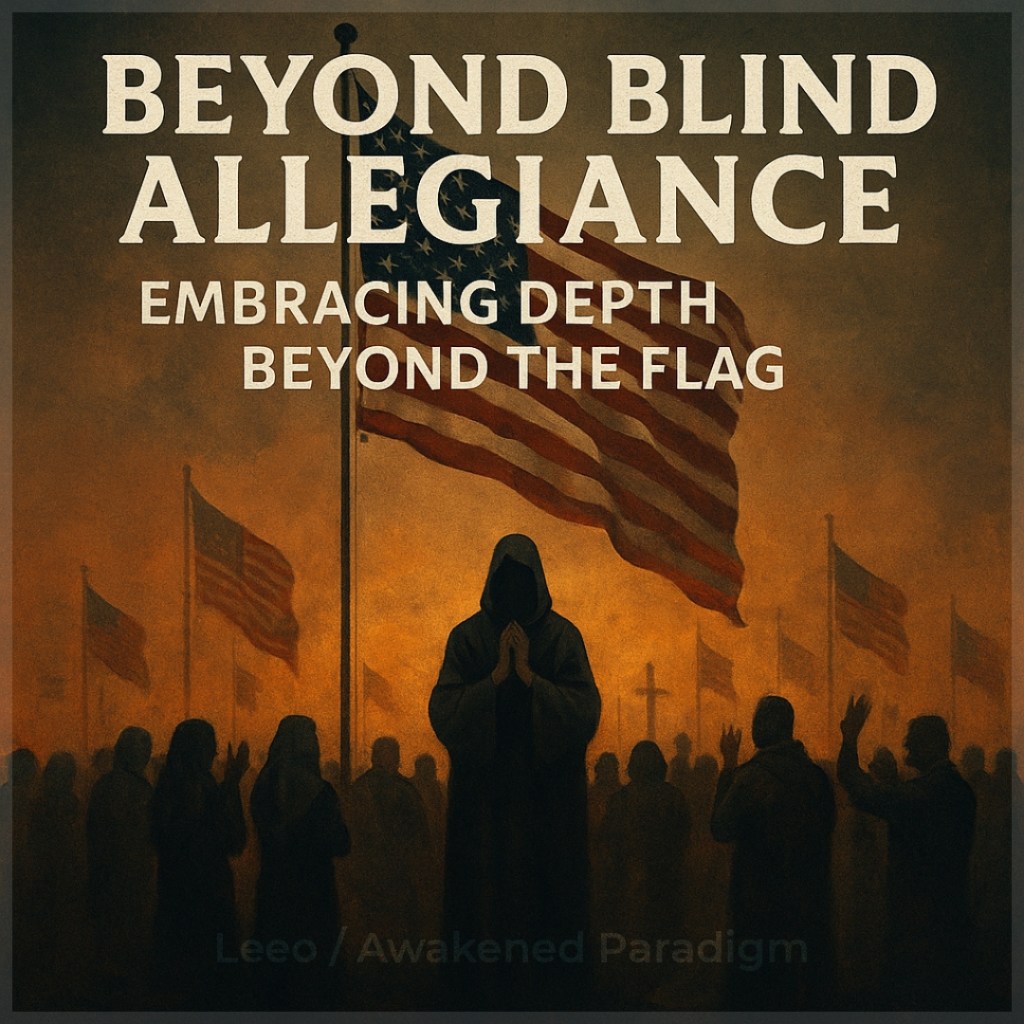
If you have been brought up with certain inherited belief systems or have been exposed to emotionally charged environments where patriotism was used as a substitute for self-reflection, inner equilibrium, or authentic moral development—there comes a point in our growth as psychospiritually sovereign evolutionaries where we must recognize the difference between genuine love for freedom and performative nationalism—and how that kind of surface-level patriotism often disguises a calcified inner landscape devoid of introspection and soulful personal development. Which means a person might appear outwardly devoted to their country, but internally, they’re stuck—unable or unwilling to evolve emotionally, spiritually, or even intellectually. This means it’s one thing to have pride in one’s country—but when that pride becomes obsessive, unexamined, and defensive, and when it’s used to avoid looking at one’s own inner emptiness, to justify the dehumanization of others, or to blindly support harmful political, cultural, or religious systems simply because they’re familiar and cloaked in tradition, we’re no longer talking about a meaningful respect for one’s place of origin or residence that leaves room for critique, growth, and shared humanity. We’re talking about a very dark and distorted form of idolization.
And when we’re around people who invest more energy into protecting patriotic symbolism than in living with ethical integrity, interpersonal responsibility, or psychological depth—more than they embody the very values their chosen symbols are meant to represent—we begin to see how a distorted and false-light version of patriotism has taken root. One where authoritarian nationalistic ideals, Pharisaic religiosity, and fixed, unreflective allegiance to ritualistic groupthink—groupthink that’s shaped by stunted self-development and a lack of societal introspection—masquerades around as moral clarity, while leaving little to no room for critical thought, inner depth, or honest ethical evaluation. And when false-light patriotism has hardened itself into a collective performance that rewards conformity to archaic ideals and unevolved collective scripts over the expansion of human consciousness, superficial image over the substance of character, and blind loyalty to inherited mythologies of national virtue over the pursuit of sincere internal moral reckoning, it becomes necessary to establish boundaries. Boundaries that are both energetic and relational—with those who are essentially channeling corrosive malignant intent through symbols of patriotism, cloaking their inner disorder in the language of nationalistic loyalty, all the while undermining the integrity, sovereignty, rights, discernment, and inner peace of anyone who refuses to submit to their stagnant, absolutist, Pharisaic, and morally performative worldview.
And when it comes to doing that—setting boundaries for ourselves with those who confuse the waving of a national flag, public declarations of allegiance, and ritualistic patriotic performance with the actual inner work of maturity, healing, and self-honesty—or for a rigid belief in their own moral infallibility—some of the deepest boundaries we can set don’t require confrontation with those that demand allegiance to their preferred myths and emotionally charged narratives at the expense of our own inner clarity. Instead, they’re internal. Because in truth, we can’t control whether someone chooses the discomfort of growing into a more honest and awake conscious human being over their ideological illusions. And so, our internal boundaries start with recognizing that someone’s performative displays of devotion to their nation’s flag, historical legacy, or institutional pride don’t necessarily reflect depth of character, capacity for honest self-examination, or a sovereign and awakened relationship with life that allows room for the expansion of human consciousness and personal evolution.
This means we can acknowledge someone’s right to feel connected to their national identity, where they have their own sovereign right to hold pride in their country and to embrace a sense of belonging through patriotic or nationalistic sentiment—while refusing to let it be used as an indicator of them having higher standards of integrity, inner maturity, moral legitimacy, or depth of thought—especially when that national identity is being weaponized to suppress, shame, or spiritually dominate others. So, for those who cultivate a mindful, healthy, and grounded relationship with civic symbols—people that are actually respectable, discerning, introspective, and committed to ethical growth—the flag may be a symbol of freedom, identity, and belonging. But that doesn’t mean every person who looks to the flag or has reverence for their nation is operating from genuine discernment or mature patriotic insight. Because those that don’t have a healthy relationship with self and are operating from false-light patriotism (which means performatively aligning with symbols and language of virtue without embodying the inner depth, moral development, or self-awareness those symbols were meant to inspire)—an underdeveloped inner life devoid of meaningful introspection, wisdom, and personal accountability often gets mistaken for principled conviction or a grounded ethical compass, when in reality, it’s little more than fear-based identity preservation cloaked in performative righteousness.
And so, those that are aligned with false-light patriotism—the emotional rigidity, intellectual complacency, deep-seated fear of powerlessness and perceived insignificance, and fear of confronting one’s own state of arrested development—those traits become the very things that drive their fervor. And that illusion of patriotic righteousness that they are clinging to—no matter how loudly it performs itself—cannot substitute for the depth of self-knowledge and human maturity that comes from authentic soul-level introspection, spiritual refinement, and intellectual expansion. Because—genuine patriotic alignment and the sense of sovereignty that one might think of when envisioning a truly liberated individual—especially the kind of sovereignty that reflects a self-governed inner landscape aligned with higher human values and a life-long commitment to consciously evolving—doesn’t automatically come from blind obedience to symbols or unquestionable allegiance to culturally inherited myths, ideological traditions, or nationalistic narratives. It comes from deep internal alignment, a conscious refusal to uphold cultural delusions of righteousness, and the courage to live from a place of integrity even when it challenges collective nationalistic and patriotic conditioning.
Because when obsession with patriotism and nationalistic identity becomes a substitute for doing the deeper work of true inner development and conscious self-examination—where healing emotional wounds, challenging inherited belief systems, and deepening a sincere sense of inner ethics would instead have flourished—it creates a façade of righteousness that’s so vacant and ungrounded at its core, it becomes an empty performance that disconnects a person further from their own integrity and depth, while also contributing to the erosion of collective conscience through the reinforcement of rigid, Pharisaic, and authoritarian social ideals. And it becomes a coping mechanism to avoid facing unresolved inner realities, and a shield to deflect from personal accountability, no matter how harmful the consequences of that avoidance may become for others.
So, in these cases, patriotism—and the nationalistic identity often fused with it—isn’t anchored in a sincere concern for the well-being of others, the thoughtful evolution of one’s country, or the personal responsibility to grow into someone who contributes to a more conscious and awakened society. Instead, it stems from a fear of losing dominance, an inability to acknowledge and integrate one’s shadow, and a need to redirect personal discomfort onto those who challenge the idealized image of noble patriotism—especially when that patriotism has been distorted into a mechanism of control, exclusion, and moral evasion. And that kind of unhealthy fixation on patriotic image at the cost of deep emotional self-integration, genuine exploration of one’s spiritual landscape, and the process of intellectual self-refinement, it doesn’t liberate—instead, it traps people mentally, emotionally, and spiritually, keeping them locked inside of rigid Pharisaic identities that demand conformity rather than expansion, obedience rather than reflection, and dominance rather than connection.

 Awakened Paradigm